A NOTE: This post is heavily featured in our April/May newsletter (you can sign up here). It's a very expansive subject so I broken in out into these blog posts.
Nerd Alert!
This is a deep-dive into some technical and obscure subjects. While not specifically about the film-making process itself this post is about the use of complex digital systems to support and enable that process.
Part 1 is available here.
I described my basic problem (it's jsut me doing this) and the solution - free the giant nerd inside me to go to town on building automated digital systems that both organize and diminish my workload.
I strongly recommend you read post that first, otherwise a lot of this might go whoosh over your head...
I Did Warn You This Was Gonna Get Nerdy 🙂
While my datatbase service Coda does have its own "A.I.", and a certain amount of automation, the real efficiency kicks in when I use Make.com's scenarios.
"Make" is an AMAZING service that lets different apps, platforms, services and off-line systems basically "talk" to each other, using a graphical builder that creates "Scenarios". Scenarios are basically automated workflows where you tell various services, platforms and files to talk to each other in a specific workflow, to get a specific set of tasks done.
Zapier is similar service (also ITTT), but it is more text based. I like Make's visual UI:
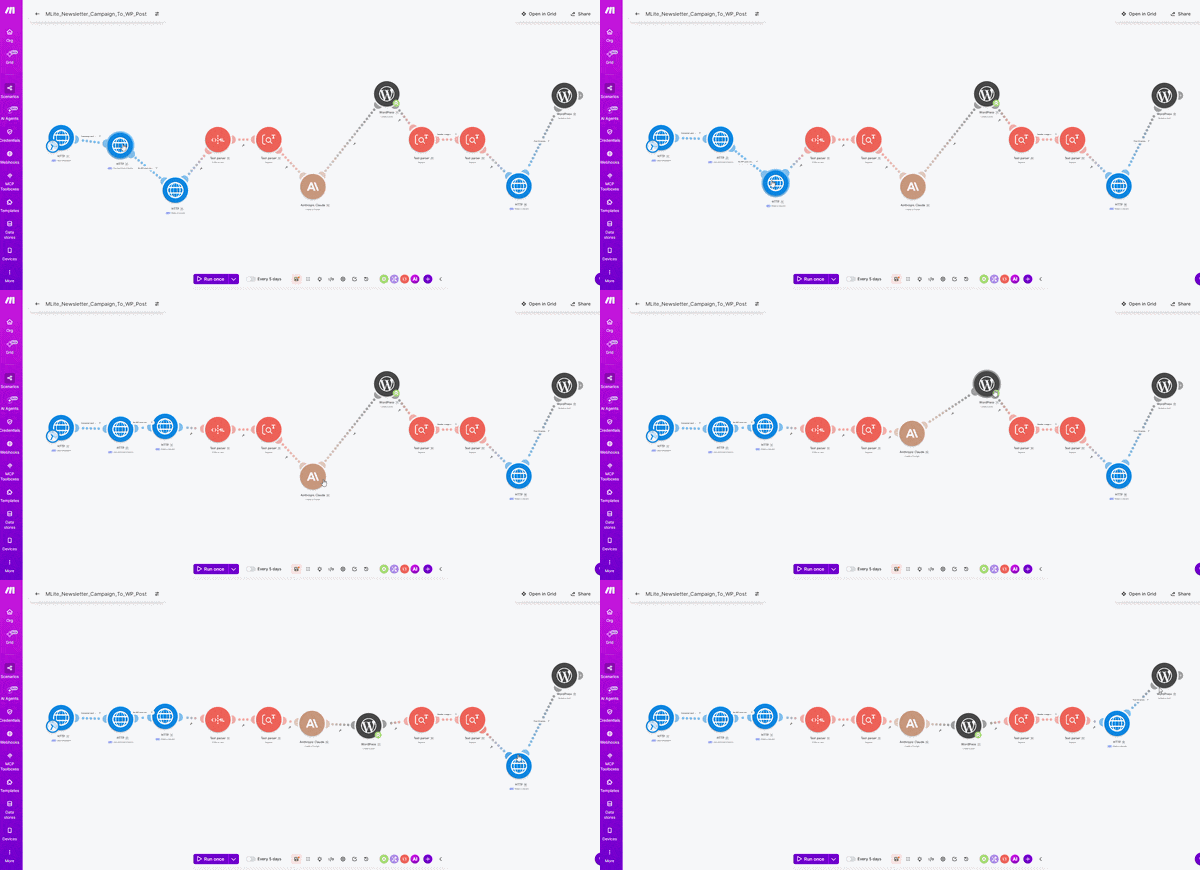
If your eyes aren't glazed over yet, try this one on for size:
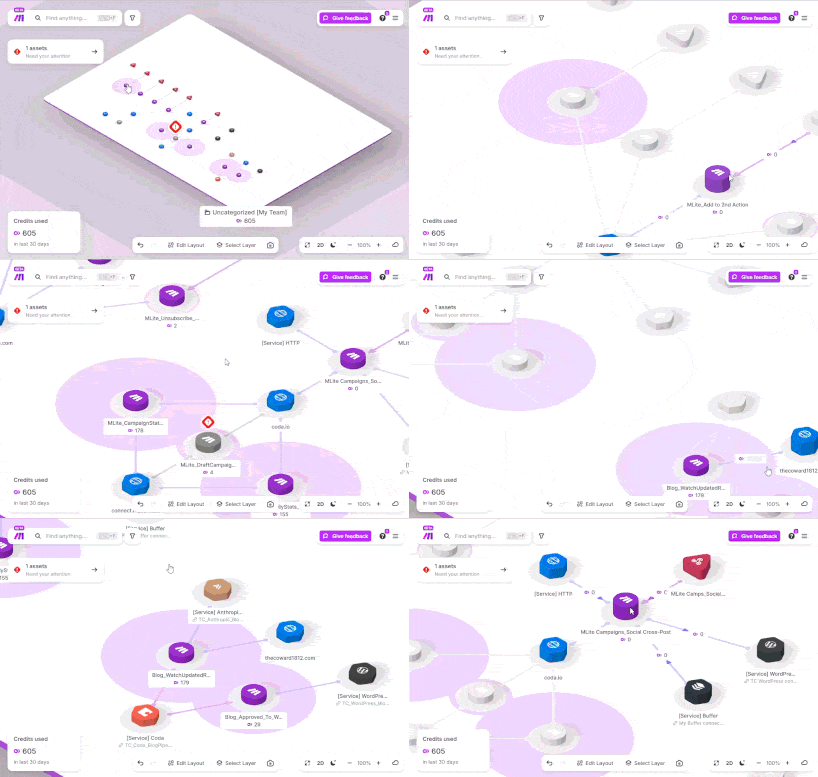
I've created Scenarios (i.e. automated connections) that connect MailerLite (my email campaign service) with a table in Coda, which displays my subscriber count, click rates, bounce rates, VIP responder, etc etc. Make also watches MailerLite and automates various categorization, segmentation, response emails and weighting patterns to help organize and streamline the subscriber base.
The above are first- and second-order effects. I do some work and its automatically spread to various channels/services/ platforms. This saves me the first stage of disseminating the information. Then antother layer kicks in and uses that information, or commands, and creates secondary effects - an email goes out; a table is populated with data; a graph is created showing trends.
Third Time's The Charm
The real amplifaction happens with third-order effects. This is where my orginal work starts to loop back to me, but with added value and effectiveness - a recursive loop.
For example - to build a lot of these automations, especially the Make.com scenarios, I've leaned on Claude AI. I did initially build scenarios in Make by hand - but the bugs, mistakes and confusion grew so, so fast that I actually stopped using Make for a while. I simply didn't know what I was doing at the level needed to achieve what I wanted.
However, this kind of digital systems building is child's play for the Claude AI.
To build those automations correctly I've had to lean on Claude AI. I did initially build scenarios by hand but very quickly my ideas outpaced my knowledge base. I quickly ran into the merciless friction of bugs, errors and simplistic builds that couldn't handle the complexity of what I needed to do. However, this kind of digital systems building is child's play for the Claude AI.
I've built a system with Claude where:
- I use Claude AI to figure out a problem and its solution,
- I copy/paste the entire chat with Claude into a table in Coda.
- Make.com sees that pasted chat in Coda and activates Claude AI to parse, reformat and re-structure the chat into a draft blog post, back into abnother column in that same Coda table.
- I edit the draft post there and select "Content Approved".
- Make sees that and activates Claude AI to create a Google Image search query, copies that into a column on the Coda table and activates an external service, SerpAPI, to search, and Claude AI to filter the results to 3 options.
- URLs for those options are pasted into 3 more columns in the Coda table.
- I select one of those options (or run a New Search routine).
- Make copies the approved content + approved image into a WordPress blog post (keeping it as draft)
- I run final edit, press Post - It gets posted on the Blog.
- Buffer notes the new blog post and propages the post out to four social media channels.
- Make sees the posted blog post and activates Claude to summarize the post and insert that into a draft email campaign in MailerLite.
- MailerLite triggers a Make scenario to add the draft email campaign to another table in Coda.
- Make sees the updated table and activates Claude to spellcheck it, rephrase it in my voice.
- I approve that draft and Make re-inserts the approved content back into the MailerLite newsletter campaign.
- Make sends me a text notification ("DRAFT EMAIL READY") and I review it, re-writing as needed. I approve, the email is scheduled for next month, and the Coda table is updated.
(There's at least five other technical steps I'm keeping out for clarity!).
You can see how I would need an AI like Claude would make this entire process even worth attempting. Otherwise it could take me months (!) to gain the required working knowledge of all these services, then start building, then deal with bugs and errors, learn more, rebuild from scratch, yadda yadda yadda. SMH, FML, as the young 'uns say.
Flying With An Autopilot
Fundamentally, I'm the sole person working on this project. I can't do everything, everywhere, all at once - there's simply too much. Plus, my day job as a 1st AD demands a lot of my time, and shoot days demand ALL of my time. I needed help.
Automating and integrating as many systems as possible, to act as virtual assistants and automatically complete multi-step task, saves me a huge amount of time. I can then invest that time-saved on what I really want to do - make the damn film!!
I think almost as important as time is my attention, my bandwidth. Just like your internet connection at home, where is only so much you can download and upload. With the system I've built (and still building) I've added one, two, maybe three more connections. I've gone from dial-up to Bell Fibre.
I now feel less overwhelmed, more in-control. I'm much less worried about this project vanishing under a cascade of vital and minor tasks that never get done.
I'm not fully alone in this workload. I can breath.
Onwards!