
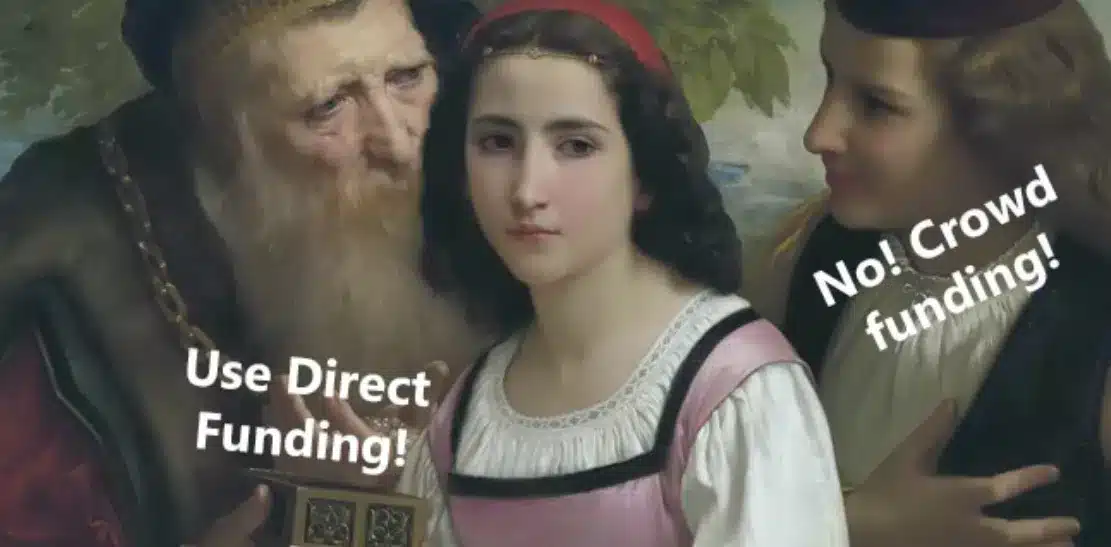
Welcome to Part 1.
Financing a short film is a journey filled with choices. As a filmmaker, I’ve faced the decision between crowdfunding and direct fundraising, and it’s a choice that can shape your entire project. Should you go for crowdfunding or direct fundraising? The right choice can mean the difference between bringing your vision to life or staying stuck in the hell of everlasting pre-production. Been there, suffered that!
1. Crowdfunding
The world of film financing has evolved dramatically over the past decade. Gone are the days when wealthy investors, grants, and film schools were the only options. Now, community-powered funding models have opened up who gets to tell stories. But, this democratization brings complexities that can surprise first-time filmmakers.
Understanding Crowdfunding for Short Films
Crowdfunding has changed how creative projects find financial support. Instead of convincing a few big investors, you’re asking dozens, hundreds, or even thousands of people to chip in smaller amounts. Platforms like Kickstarter, Indiegogo, and Seed&Spark have launched countless short films that might have never been made otherwise.
The beauty of crowdfunding is its accessibility. Anyone with a compelling idea and good communication skills can potentially raise the budget needed for their short film. This has led to a burst of diverse voices and stories that traditional funding might have ignored.
The Benefits of Crowdfunding Your Short Film
From my experience, crowdfunding offers more than just money. When you start a campaign, you’re not just raising funds – you’re building an audience before your film even exists. Each backer becomes an invested part of your project’s success, creating a ready-made audience to promote your film upon release. This early audience development is invaluable, especially for new filmmakers without established networks.
Crowdfunding also gives you creative freedom that’s often impossible with traditional investors. When many people each contribute small amounts, no single backer can demand changes or interfere with your vision. This independence lets filmmakers take risks and tell authentic stories without compromise, which is crucial for short films that explore experimental or niche subjects.
Plus, a successful crowdfunding campaign is proof of concept. It shows that your idea resonates with an audience, which can be a big help when approaching festivals, distributors, or investors for future projects. Many filmmakers have used the momentum from a successful crowdfunding campaign to open doors that would otherwise remain closed.
Potential Pitfalls and Challenges
Despite its perks, crowdfunding comes with significant challenges. It’s hard to believe, but the amount of work needed for a successful campaign is often underestimated. Creating compelling videos, writing persuasive copy, designing rewards, and promoting your campaign on social media requires skills that many filmmakers haven’t developed and time they hadn’t planned for.
Campaign fatigue is real – for both creators and backers. Your social network might get tired of repeated requests for support, and keeping enthusiasm high throughout a 30-day campaign requires constant energy and creativity. Many filmmakers say running their crowdfunding campaign was as exhausting as the actual film production, and running the two at the same time is a serious problem. One should lead to the other, not compete for your time, attention and resources.
There’s also the public risk of failure. Unlike private rejection from a grant or investor, an unsuccessful crowdfunding campaign plays out in front of your professional network. This visibility adds pressure and can be emotionally taxing if your campaign struggles to gain traction. It also doesn’t help if you fail and need to try again. How do potential funders know that you’ll fund this time? Because you say so? The threshold of trust gets raised significantly higher.
The Hidden Costs of Crowdfunding

First-time crowdfunders often overlook the full financial picture of their campaigns. Platform fees typically take 5-10% of your total raise, payment processing adds another 3-5%, and fulfilling backer rewards can eat up a surprising portion of your budget. Many successful campaigns end up with only 60-70% of their raised funds available for production after these expenses! Oh dear.
Tax implications also catch many filmmakers by surprise. In most countries, crowdfunding income is taxable, which can create an unexpected financial burden if not properly planned for. The administrative overhead of tracking hundreds of backers, managing reward fulfillment, and maintaining communication throughout production adds another layer of complexity that diverts focus from the creative process.
The Long-Term Benefits of Community Building
Perhaps the most overlooked aspect of the funding decision is how it affects a filmmaker’s career trajectory. Crowdfunding, despite its challenges, excels at building a community around both the project and the creator, and this community then becomes long-term asset that extends far beyond the current production.
Essentially, filmmakers who successfully crowdfund often develop a loyal following that will support their work for years to come. Each project builds upon the previous one, potentially making subsequent fundraising efforts easier as the filmmaker’s reputation and loyal audience grow.
From Short to Feature: Success Stories
The journey from crowdfunded short to feature film is exemplified by Damien Chazelle’s “Whiplash.” Before becoming an Oscar-winning feature, “Whiplash” began as an 18-minute short film partially funded through crowdfunding. The short, which premiered at Sundance and won the jury award, served as proof of concept that helped secure the $3.3 million needed to produce the feature version. The community built during the crowdfunding phase became early advocates for both the short and subsequent feature.
Similarly, Jim Cummings’ “Thunder Road” began as a Sundance-winning short film funded through Kickstarter. The positive reception and built-in audience helped Cummings launch a second, larger crowdfunding campaign that raised over $190,000 to expand the concept into a feature film. The feature went on to win the Grand Jury Prize at SXSW and secure distribution, demonstrating how the community-building aspect of crowdfunding can create a sustainable path to larger projects.
Building a Sustainable Filmmaking Career
The relationships developed through crowdfunding can provide more than just financial support. Many filmmakers find that their backers become collaborators, offering skills, equipment, locations, and connections that reduce costs on future projects. This network effect can make each subsequent production more efficient and ambitious.
Additionally, a demonstrated ability to mobilize an audience makes filmmakers more attractive to traditional funders. Grant committees and investors are increasingly looking at a filmmaker’s community engagement as an indicator of potential success. It’s pretty simple – a proven track record of building and maintaining an audience represents a lower risk investment than one without such a following. Back the winner = make money.
Part 1 conclusion
There are tangible and intangible benefits to Crowdfunding. Sometimes I feel like the grants approach is trying to convince five people (who you’ll never meet, know nothing about, can’t converse with and have no idea how they’ll react) to give you $50,000.
Crowdfunding instead lets you find, select and ask 500 people that you can be reasonably sure will be interested in you project, ask them for $100 each and spend some time and money convincing them. The trick, of course, is the first part – finding them.
This is hard, time consuming and can easily distract from more creative work. It’s a serious workload so its best if you can find someone to handle it for you or, failing that, automate as much of the process as you can (I’ll write up another article in the future on that automation).
“DoThis One Thing For Instant Results!!!” …NOT.
Crowdfunding is a long lead-time process. There are no shortcuts. Money works for some of it and time always runs out. So no matter what, the single best thing you can do is – start early. Start now. Go.
Go!
Next week: Part 2 – Direct Fundraising!
 ?
?